Working Paper · 2026
Pre-registeredCrowdfundingBehavioral strategy

Verdicts,
Not Evidence

How entrepreneurs learn from crowdfunded market tests

Founders’ stated beliefs respond to whether a campaign cleared its goal, whereas their venture commitments scale with the absolute funding raised.

9,322
Kickstarter creators surveyed
and matched to platform records
107.5%
Estimated break in belief updating,
at each founder’s own goal
11/11
Categories preserving the estimated
magnitude & goal-attainment signs
548
Held-out projects on which
the associations replicate
The central result

A dissociation between founders’ beliefs and venture commitment in response to a market test.

A completed campaign yields two distinct quantities: a verdict — whether total pledges exceeded the founder’s self-chosen goal — and a magnitude, the level of demand the market revealed. Beliefs and venture commitment prove to be associated with different quantities, and this separation organizes the analysis.

Beliefs · the founder

Tracking the verdict

In exploratory estimates, posterior confidence rises by roughly half a standard deviation as the goal is crossed and climbs steeply over the next several points of overfunding, then flattens. Beyond about 125% of goal the estimated slope is statistically indistinguishable from zero.

on the verdict+0.279***
on the money−0.065
Commitment · the venture

Tracking the magnitude

Going full-time, establishing a formal organization, and hiring are associated with the absolute dollars raised, rising continuously and convexly through the very region in which measured beliefs have stopped moving. In these exploratory estimates, goal-relative performance adds little once magnitude is accounted for.

on the money+0.270***
on the verdict−0.006

Because beliefs and commitment are associated with largely orthogonal components of the same signal, stated beliefs do not appear to be a sufficient summary statistic for commitment — a wedge that single-parameter accounts of learning from the market do not readily generate. The component beliefs appear to discount is nonetheless informative: funding beyond the kink still predicts realized revenue and personal earnings, even conditional on the beliefs founders themselves report. The pattern is consistent with founders setting aside demand information that forecasts their own subsequent sales — exploratory associations, not established causal effects.

Abstract

Crowdfunding hands entrepreneurs something rare: a mass-produced market experiment that returns both a verdict (the goal is reached or not) and a continuous measure of demand (how much was raised). Studying 9,322 Kickstarter creators surveyed about motives, beliefs, and post-campaign choices and matched to platform records, we document a double dissociation in how founders process this information.

Posterior beliefs about market demand are purely reference-dependent: holding dollars raised constant, they track only performance relative to the founder's self-chosen goal — jumping at the threshold, responding steeply for the first ten points past it, and flattening thereafter — while loading negatively on absolute scale. Venture commitment shows the mirror image: it tracks absolute dollars raised, with zero weight on the goal-relative verdict.

The belief kink is located uniquely at the founder's own goal, replicates with frozen specifications in split halves and a held-out sample, and is costly: funding magnitude beyond the threshold still predicts realized revenue and earnings. The verdict-reading is universal — in pre-registered tests, creators who launched explicitly "to see if there was demand" (39%) update no more elastically than others. Founders' minds read the verdict; their ventures follow the money; and the evidence in between goes largely unused.
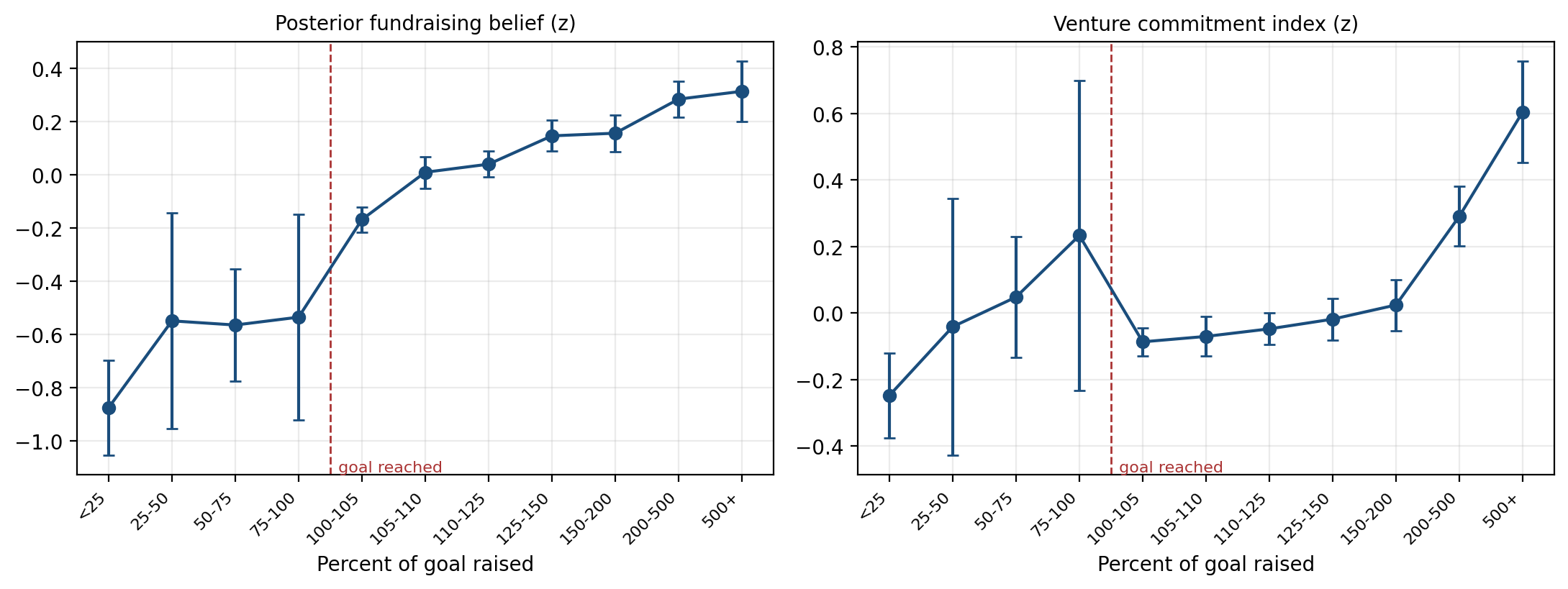
Figure 1

Discontinuity in beliefs, continuous scaling of commitment.

Two panels: posterior beliefs jump at the funding goal and saturate; venture commitment rises continuously with the amount raised.

Posterior beliefs (left) step up at the goal and saturate beyond about 125%; venture commitment (right) rises continuously and convexly with magnitude. Descriptive bin means with 95% confidence intervals, pooling funded and failed projects; the dashed line marks the funding goal.

Estimation

Jointly estimating funding magnitude and goal attainment.

Because founders set their own goals, two projects can raise identical dollars against very different targets. That variation — identified from self-chosen goals, and therefore associational — lets us estimate the partial associations of absolute funding and goal-relative performance jointly. The two loadings separate cleanly across the belief and commitment equations.

Loads on the money
ln(pledged)
Loads on the verdict
ln(pledged / goal)
Posterior belief −0.065 +0.279***
Venture commitment +0.270*** −0.006
Realized revenue +0.97*** +0.76***

Standardized coefficients · category × launch-year fixed effects · full controls · *** p < .001. Realized revenue is associated with both components — absolute scale and goal-relative demand each predict sales — so the funding magnitude not reflected in stated beliefs is, descriptively, associated with measurable outcomes. Estimates are exploratory and associational.

Inference & robustness

Pre-registration preceded estimation; results replicate on held-out data.

01Locked before estimation

Hypotheses, variable constructions, specifications, inference, diagnostics, and the analyst’s own numerical priors were registered before any independent–dependent relationship was examined. The confirmatory test — whether experimental intent moderates the elasticity of belief and commitment to the funding signal — returned a bounded null, which we report as such.

02A held-out sample

The registration’s size floors had excluded 548 funded projects from every discovery analysis. With the specifications frozen, the belief kink and the money-loading of commitment both reproduce on these data, which the discovery analyses had never seen.

03The kink, bootstrapped

A grid search locates the break in the belief response at 107.5% of goal, with a bootstrap 90% interval of [105%, 135%] and 99% of draws below 150%. The break sits near the founder’s own aspiration level rather than at any round multiple of it.

04Disclosure of exploratory analyses

The dissociation was discovered rather than predicted, and we treat it as exploratory and associational throughout. Seeded split-half samples reproduce every principal coefficient, the estimated signs from the joint specification are preserved in 11 of 11 categories with at least 150 observations, and a deviations appendix documents which analyses were exploratory and why.

Materials

Full paper and supporting materials.